Build on Airscope#
Airscope is designed not only as a ready-to-use wireless miniscope, but also as an open and modular platform for future wireless miniscopes. We encourage researchers to use Airscope as a starting point and adapt the optics, electronics, power system, or software interface for their own applications.
Extend the Optics#
The Airscope electronics can be used as a compact wireless acquisition backend with customized optical modules. Users can mount their own optical assembly above the Airscope image sensor and reuse the existing wireless recording, illumination driving, power management, and DAQ workflow.
This is useful if users want to test a new lens, filter set, illumination geometry, or miniscope body without redesigning the electronics. If no customized synchronization or control logic is needed, most of the data acquisition workflow can remain unchanged.
Extend the Electronics#
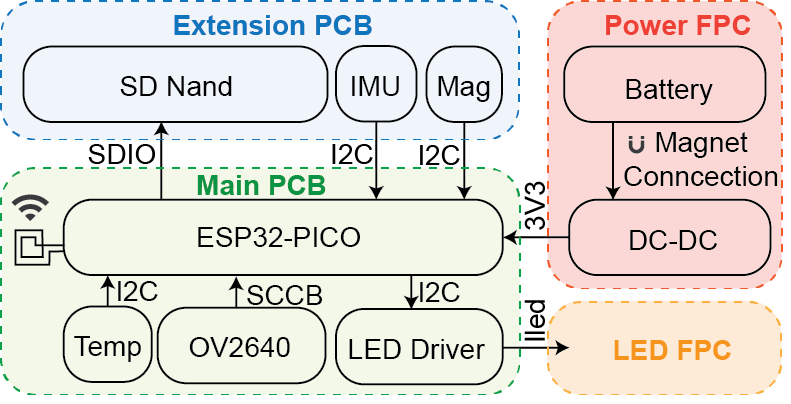
Airscope adopts a modular electronics design.#
Airscope uses a modular electronics design to support easy extensions.
New functionalities can be added to Airscope with this modular design. For example, users can modify the extension PCB to quickly add additional sensors or stimulation controls without changing the main PCB. Firmware updates are straightforward and can be done in the Arduino IDE.
The power management PCB is also designed to be separated from the main PCB. This supports future adaptation to wireless power transmission, enabling longer or potentially unlimited imaging sessions.
Extend the Software#
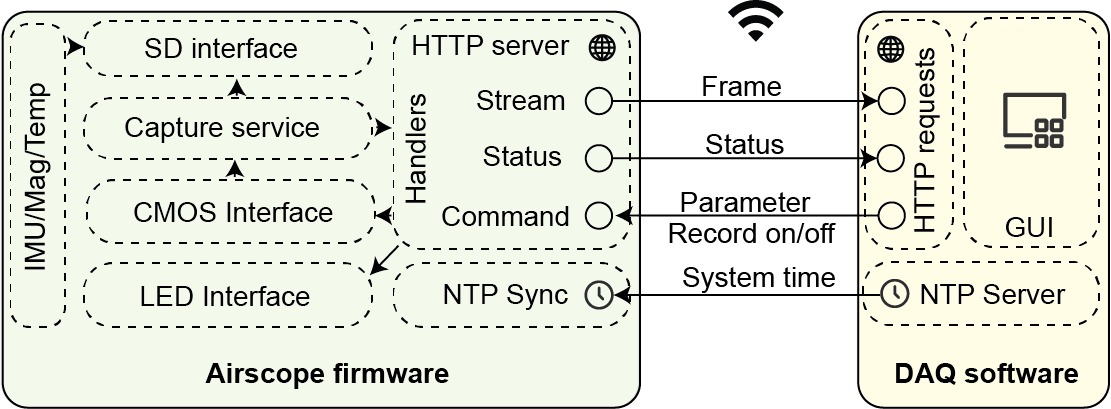
Airscope communicates with the software through a standard HTTP interface.#
We provide dedicated DAQ software for easy control and monitoring. However, we also understand that some researchers may prefer to use their own DAQ software in the lab to best fit their experimental needs. The communication interface to Airscope uses standard HTTP and supports exposure control, frame acquisition, and recording control. This makes it relatively straightforward to incorporate Airscope into custom Python, MATLAB, Bonsai, or other DAQ frameworks.
Inside Airscope Designs#
We are also working on sharing the detailed design considerations behind Airscope. These materials will walk through the key considerations in the optics, electronics, power system, and firmware, helping users understand the design logic behind Airscope and adapt the system for their own applications in wireless neural imaging and beyond.